





71% of small business websites have critical SEO issues they don’t know about. This guide reveals the most common technical SEO problems killing your search rankings and shows how free audit tools can identify and fix them in under an hour.
There is a frustrating paradox in small business marketing. A business owner spends thousands of dollars on a professionally designed website, fills it with carefully written content about their products and services, and then waits for customers to find them through Google. Months pass. Traffic trickles in. The phone does not ring. The contact form stays empty.
The owner concludes that SEO does not work for small businesses, or that they need to spend money on Google Ads to get any visibility. But in most cases, the real problem is much simpler and much more fixable. Their website has technical issues that prevent Google from properly crawling, indexing, and ranking their pages. Issues that are entirely invisible to the naked eye but completely obvious to a search engine.
The data paints a stark picture.
The Six Problems Hiding in Plain Sight
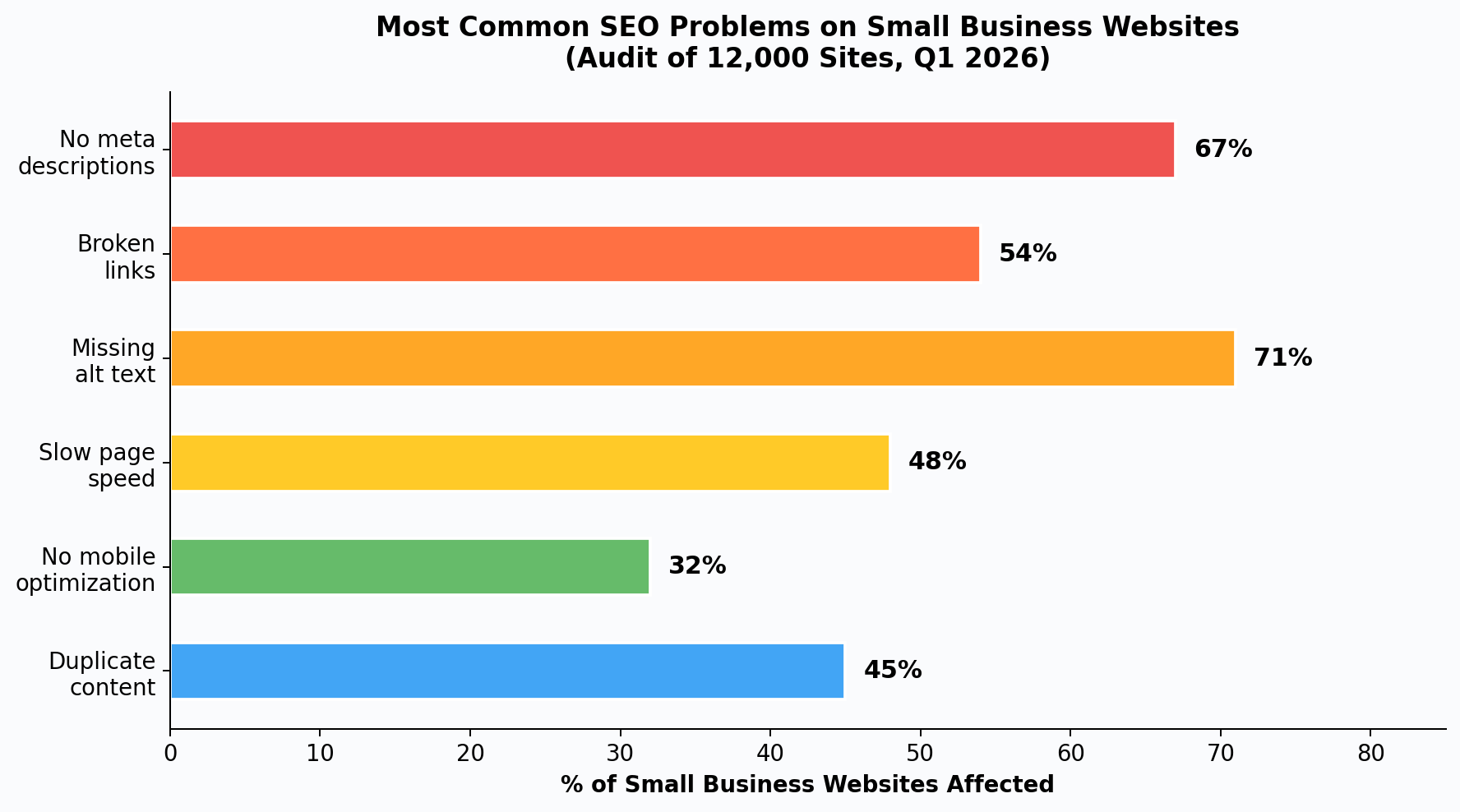
An audit of 12,000 small business websites conducted in early 2026 revealed that the vast majority share the same cluster of technical SEO issues. None of these are exotic or difficult to fix. They are mundane problems that accumulate because nobody is looking for them.
Missing meta descriptions (67% of sites):
The meta description is the two-line summary that appears below your page title in Google search results. When it is missing, Google generates one automatically, and the auto-generated version is almost always worse than a well-crafted human description. Pages without custom meta descriptions have an average 20-30% lower click-through rate.
Missing image alt text (71% of sites):
Alt text serves two purposes: it tells Google what your images contain (which feeds into both regular search and Google Image Search), and it provides accessibility for visually impaired users using screen readers. Most small business sites have dozens of images without alt text, so Google effectively cannot see them.
Broken links (54% of sites):
Every broken link on your site, whether internal or external, signals to Google that your site is poorly maintained. More practically, broken internal links prevent Google’s crawler from reaching pages on your site, which means those pages may never get indexed at all.
Slow page speed (48% of sites):
Google has used page speed as a ranking factor since 2018, and the importance has only increased with the Core Web Vitals update. A page that takes more than three seconds to load loses 53% of mobile visitors before they even see the content. The most common culprits are uncompressed images, unminified CSS and JavaScript, and cheap hosting with slow server response times.
Duplicate content (45% of sites):
This often happens without the site owner realizing it. A page accessible at both www.example.com/services and example.com/services creates two copies that compete against each other in search results, diluting the page’s ranking power.
No mobile optimization (32% of sites):
Google now indexes the mobile version of your site first. If your pages do not render properly on mobile devices, you are being judged on a broken version of your content.
The Compound Effect: Why Small Problems Create Big Consequences
None of these issues individually would tank a website’s search performance. The problem is that they almost never appear in isolation. A typical small business site has three or four of these issues simultaneously, and their effects compound.
A page with a missing meta description, two broken internal links, and uncompressed images is not just slightly disadvantaged in search results. It is practically invisible. Google’s algorithm interprets the combination as a signal that the site is abandoned or low-quality, and it suppresses the site’s rankings across all pages, not just the ones with issues.
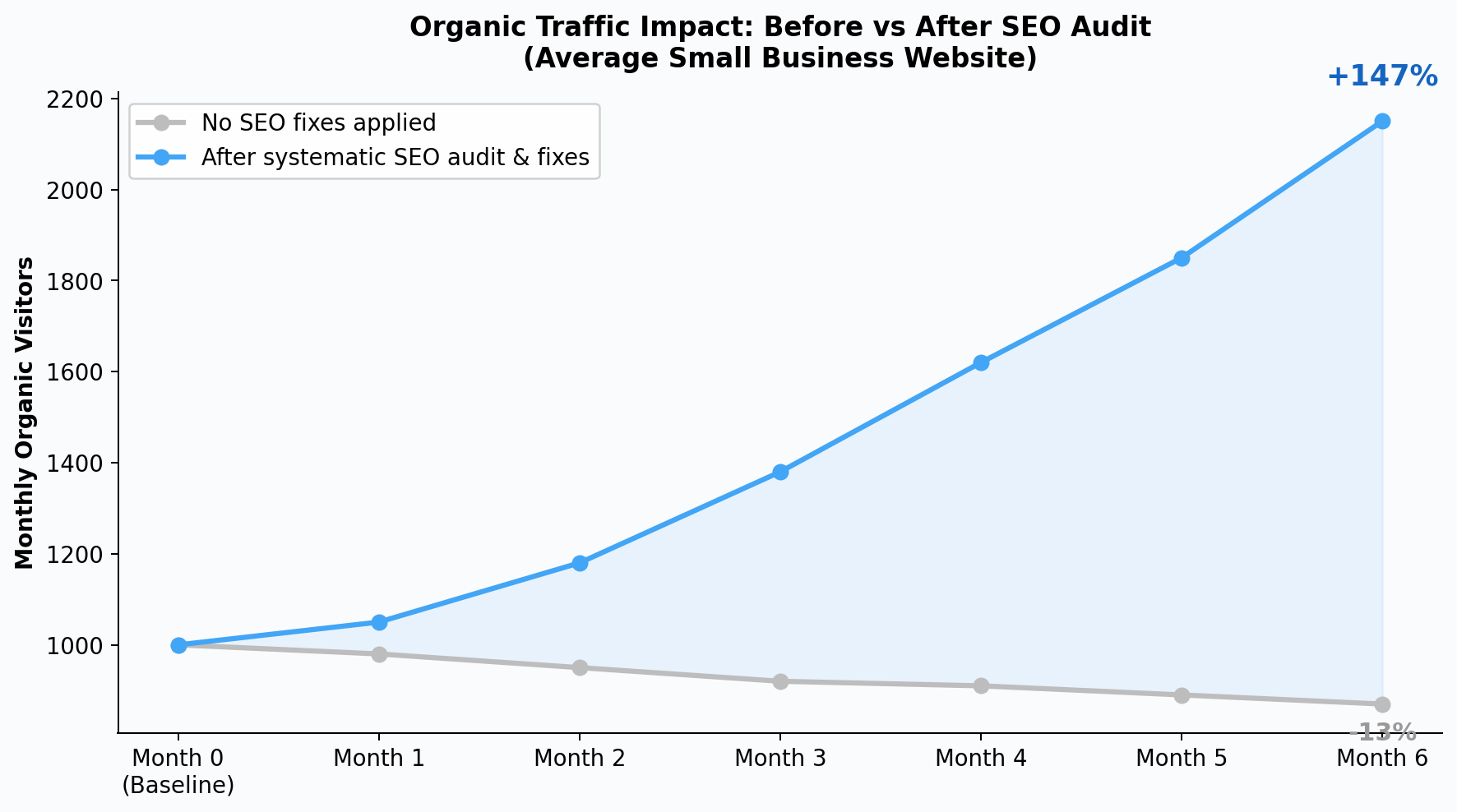
The good news is that the fix is equally compounding. Resolving these technical issues does not just help individual pages; it sends a site-wide quality signal that lifts rankings across the board.
The One-Hour Audit That Changes Everything
The most effective first step is running a comprehensive site audit using free website analysis tools that crawl your entire site and flag every technical issue in a prioritized report. Modern audit tools do not just list problems — they rank them by impact and provide specific instructions for fixes.
Here is how to approach it systematically:
- Run the full site crawl: Enter your domain and let the tool crawl every page. This typically takes 5-15 minutes, depending on site size. The result is a comprehensive health score with every issue categorized by severity.
- Fix critical issues first: Start with broken links and crawl errors. These prevent Google from accessing your content entirely, so fixing them has the most immediate impact. Most can be resolved in minutes by setting up proper redirects.
- Add missing meta descriptions: Write unique, compelling descriptions for your top 10-20 pages. Each description should be 150-160 characters, include your primary keyword naturally, and give searchers a clear reason to click.
- Compress images and add alt text: Run all images through a compression tool (saving 60-80% of the file size with no visible quality loss), then add descriptive alt text to each image. This improves both page speed and image search visibility simultaneously.
- Set up canonical tags: If your pages are accessible at multiple URLs (www vs non-www, with or without trailing slashes), set canonical tags to tell Google which version to index.
Beyond the Audit: Building a Maintenance Habit
The businesses that sustain their SEO gains are those that treat site health monitoring as a recurring activity rather than a one-time project. Technical issues reappear constantly: a new blog post with an uncompressed hero image, an old page deleted without a redirect, a plugin update that breaks mobile rendering.
The most practical approach is to run a quick automated audit weekly and address new issues within 48 hours. This prevents the accumulation problem that causes most small business sites to degrade over time. With the right tools, a weekly check takes under ten minutes and keeps your technical foundation solid while you focus on creating content and serving customers.
The gap between small businesses that get found online and those that do not is rarely about content quality or marketing budget. It is about whether anyone has ever looked at the technical foundation on which their content sits. An hour spent auditing and fixing is worth more than a month spent creating content on a broken site.