




If your last experience with a website chatbot involved clicking through a frustrating decision tree that ended with “I’m sorry, I didn’t understand that. Let me connect you with a human agent,” you are not alone. For years, chatbots were a punchline – a technology that promised to revolutionize customer service and instead delivered a worse experience than the email inbox it was supposed to replace.
But something fundamental changed between 2023 and 2026. The large language model revolution did not just improve chatbots. It rebuilt them from the ground up. The chatbots appearing on websites today are not upgraded versions of the old decision trees. They are an entirely different technology wearing a familiar interface.
And the data shows that customers have noticed.
The Numbers That Should Make Every Business Owner Pay Attention
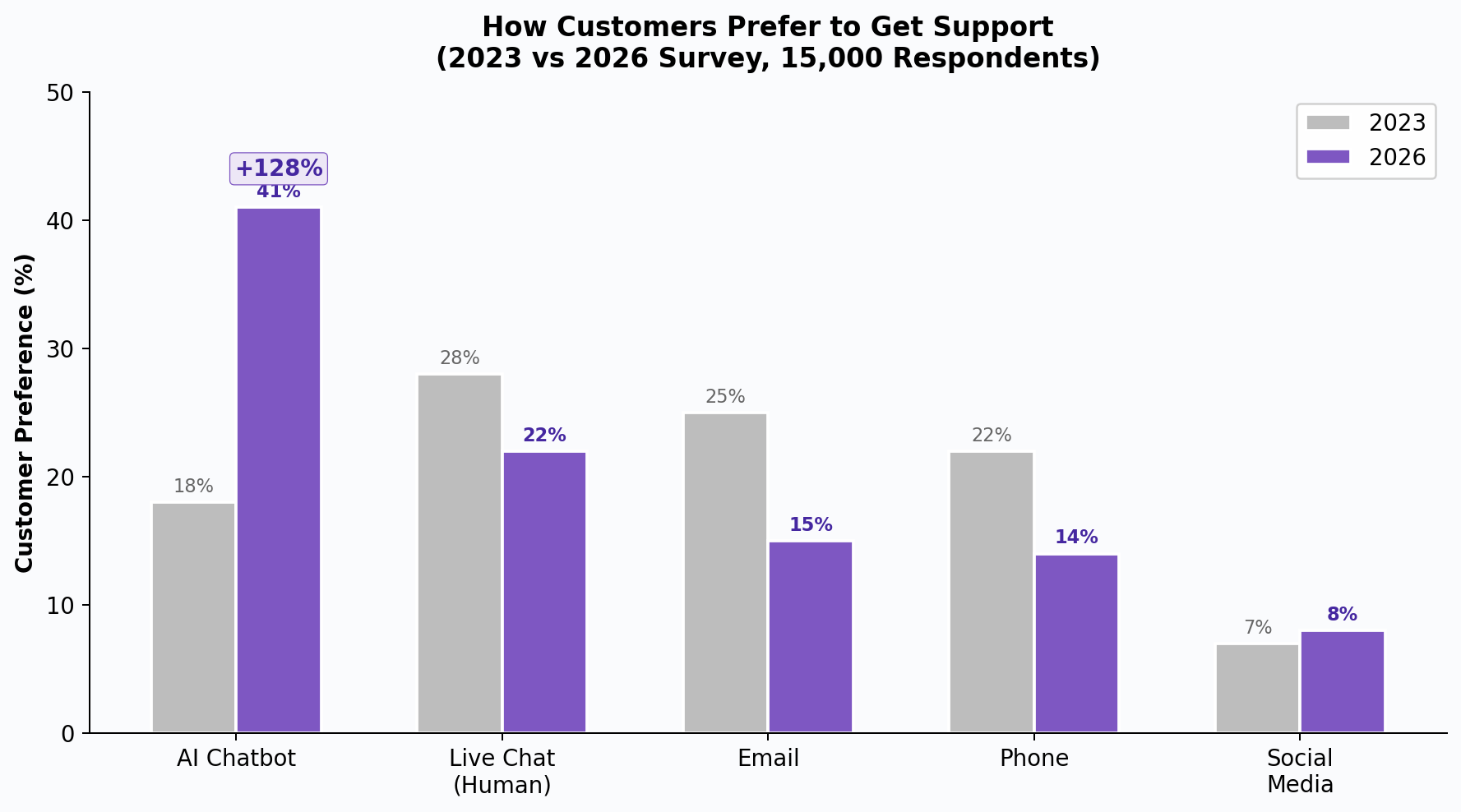
In 2023, only 18% of customers preferred interacting with an AI chatbot over other support channels. By early 2026, that number has jumped to 41%, making AI chatbots the single most preferred customer support channel for the first time in history, surpassing live human chat, email, phone, and social media.
This is not because customers suddenly became more tolerant of bad experiences. It is because the experience changed beyond recognition. Modern AI chatbots understand context, remember previous messages in a conversation, handle complex multi-step queries, and respond in natural language that feels like talking to a knowledgeable colleague rather than navigating a phone menu.
Perhaps most importantly, they respond instantly and are available around the clock. In a world where 82% of customers expect an immediate response to sales and marketing questions, the speed advantage alone makes AI chatbots the rational default for businesses that cannot staff 24/7 support teams, which is to say, most businesses.
What Actually Changed: The Technology Behind the Shift
The old chatbots were rule-based systems. A developer would map out a decision tree: if the customer says X, respond with Y, and offer options A, B, or C. Any query that did not match a pre-defined path would fail. These systems were brittle and limited, which gave chatbots their reputation for being useless.
Modern AI chatbots are built on large language models, the same underlying technology behind tools like ChatGPT, Claude, and Gemini. Instead of following a script, they understand natural language, interpret intent, and generate responses dynamically. A customer can ask the same question ten different ways and get a helpful answer every time, because the model understands meaning rather than matching keywords.
But the real breakthrough for business applications is not just the language understanding. It is three capabilities that transform chatbots from novelty to necessity:
- Context awareness: Modern chatbots ingest your entire website, product documentation, FAQ database, and pricing information. When a customer asks a question, the bot does not search for keywords — it understands the question in the context of your specific business and provides an answer drawn from your actual content. This means the chatbot knows your products as well as your best salesperson.
- Voice and text: The latest generation of AI chatbots does not just type responses — it speaks them. Voice AI has reached a level of naturalness that, in blind tests, customers cannot consistently distinguish AI voice from human voice. For businesses, this means a single chatbot can handle customers who prefer reading and customers who prefer talking, through the same interface.
- True multilingual capability: This is the change that has the largest practical impact for businesses operating globally. Modern AI chatbots do not rely on translation APIs bolted onto an English-language system. They natively understand and respond in dozens of languages, maintaining context, cultural nuance, and technical accuracy across them all.
The Multilingual Problem That Most Businesses Cannot Solve – Until Now
Here is a statistic that reveals one of the largest gaps in how businesses serve their customers: while 71% of European businesses have websites available in their customers’ local languages, only 42% offer customer support in those same languages. In Latin America, the gap is even wider-45% localised websites but only 18% localised support. In the Asia Pacific, it is 38% versus 15%.
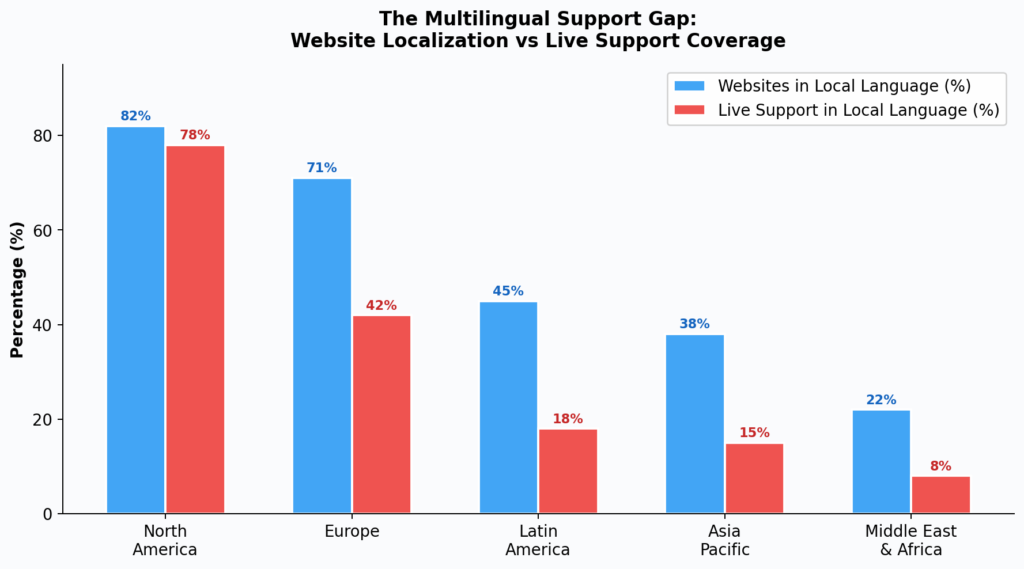
This gap represents a massive missed opportunity. Research from the Common Sense Advisory consistently shows that 76% of online consumers prefer to buy products with information in their native language, and 40% will never buy from websites in other languages. Businesses that localize their websites but not their support are effectively inviting customers in through the front door and then failing them at the point where they need the most help.
The reason for this gap has always been economic. Hiring multilingual support staff is expensive, especially for less common language pairs. A European SaaS company that needs support in English, French, German, Spanish, Portuguese, Dutch, Italian, Swedish, and Polish would need a minimum team of nine language-fluent agents — an overhead that most small and mid-size companies cannot justify. AI chatbot platforms that support 95+ languages eliminate this constraint entirely. A single implementation covers every language your customers speak, without hiring, training, or managing multilingual staff.
What to Look for in a Modern AI Chatbot
If you are evaluating AI chatbot solutions for your business in 2026, the market has matured enough that there are clear differentiators between good and mediocre implementations:
- Content ingestion: The chatbot should automatically scan and learn your entire website, without requiring you to manually input Q&A pairs. If you need to write a script for the bot to follow, you are looking at old technology.
- Voice capability: Text-only chatbots are already becoming outdated. Look for platforms that offer both text and voice responses natively, allowing customers to choose their preferred mode.
- Language breadth: Do not settle for five or ten languages. The top platforms now support 80-100+ languages, meaning you can serve virtually any customer visiting your site without additional configuration.
- Setup time: A modern AI chatbot should be functional within hours, not weeks. If a vendor quotes a multi-week implementation timeline, their technology likely involves significant manual configuration rather than genuine AI learning.
- Analytics and insights: Beyond answering questions, your chatbot should tell you which questions customers ask most frequently, where the bot struggles, and which content gaps exist on your site. These insights are often more valuable than the automated responses themselves.
The Business Case in Numbers
The economics of AI chatbots in 2026 are compelling enough that the question is no longer whether they make financial sense, but how quickly a business is losing money by not implementing one.
A typical mid-size e-commerce site with 100,000 monthly visitors and a 2% conversion rate generates 2,000 sales per month. Industry data shows that AI chatbots increase conversion rates by 15-35% by answering purchase-blocking questions in real time. Even at the conservative end, that is 300 additional sales per month – likely worth far more than the monthly cost of any chatbot platform.
On the support side, businesses report that AI chatbots resolve 65-80% of customer queries without human intervention. For a company processing 1,000 support tickets per month at an average handling cost of $12 per ticket, automated resolution of 700 tickets saves $8,400 monthly – again, typically a multiple of the chatbot’s cost.
The Shift Is Already Happening
The customer preference data tells the story clearly. The majority of online consumers now prefer interacting with a well-implemented AI chatbot over waiting for a human agent. They prefer the instant response. They prefer the 24/7 availability. And increasingly, they prefer the quality of the answers – because a chatbot that has ingested your entire knowledge base can access information faster and more completely than even your most experienced support agent.
For businesses, the practical implication is simple. The chatbot widget in the corner of your website is no longer a nice-to-have feature or a cost-cutting measure. It is becoming the primary channel through which customers interact with your business. The ones that are powered by genuine AI, that speak your customers’ languages, and that understand your products – those are the ones converting visitors into customers while their competitors are still routing people to an email form.