



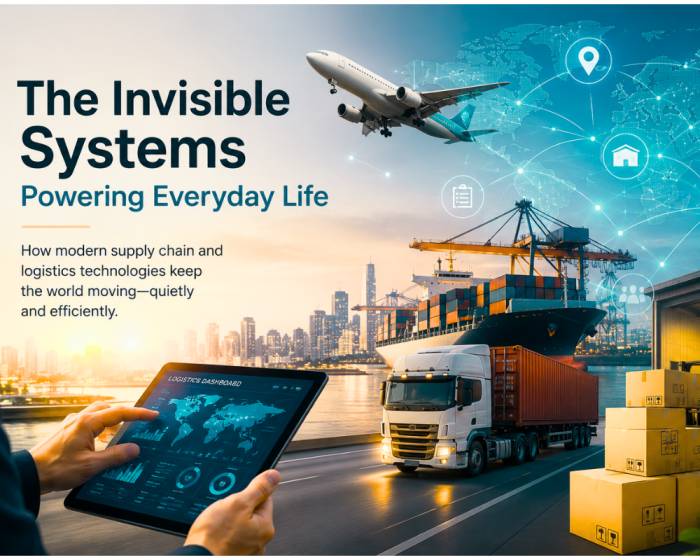
Most people rarely think about the systems operating quietly in the background of daily life. Groceries arrive on shelves, online orders appear at front doors, businesses receive supplies, and services continue running without interruption. Because these processes often work smoothly, they become almost invisible.
Yet behind everyday convenience sits a complex network of technology, logistics, planning, and coordination systems designed to keep everything functioning. Modern life relies heavily on infrastructure that most people never see. Increasingly, these systems are becoming more intelligent, connected, and responsive to changing demands. Supply chain and logistics technologies now play a major role in improving visibility, efficiency, and operational performance across industries.
1. Logistics Networks Quietly Support Daily Life
Whether someone orders furniture online, relocates to another city, or receives a same-day delivery, transportation systems are constantly working in the background.
Logistics networks involve far more than simply moving products from one location to another. They require route planning, scheduling, timing coordination, storage systems, inventory visibility, and communication between multiple providers. Efficient logistics operations are increasingly viewed as essential for customer experience and business performance.
When these systems work properly, most people never notice them. Attention usually only arrives when something breaks down.
2. Real-Time Information Has Changed Expectations
Modern consumers expect visibility throughout the services they use. People want delivery updates, tracking information, appointment confirmations, and immediate access to status changes.
This demand has transformed how operational systems function behind the scenes. Real-time tracking technologies, integrated platforms, and connected data systems now help businesses monitor activity continuously. Real-time visibility has become a defining characteristic of modern supply chain systems.
Rather than relying solely on static schedules, organisations increasingly adapt to changing conditions as events unfold.
3. Smarter Coordination Reduces Friction
Many inefficiencies happen when systems operate independently rather than collaboratively.
Historically, supply chains often relied on disconnected processes and siloed information. Modern approaches increasingly focus on integration and shared visibility between organisations and service providers.
For transportation-related needs, Staten Island car transporters can help connect transport requirements with available providers, simplifying a process that would otherwise involve far more manual coordination and searching.
Removing friction often creates smoother experiences without people ever noticing the systems working in the background.
4. Automation Is Becoming Part of Everyday Operations
Automation increasingly supports tasks once managed entirely through manual effort.
Warehousing systems, scheduling tools, route planning software, and predictive systems are helping organisations improve speed and reduce inefficiencies. Research continues to show that automation technologies play an increasingly important role in operational efficiency and sustainability.
While people often associate automation with futuristic ideas, much of it already exists quietly behind routine experiences.
5. Information Flows Matter as Much as Physical Movement
When people think about supply chains, they usually imagine vehicles, warehouses, and deliveries. Information flow can be equally important.
Accurate communication between systems helps organisations avoid delays, improve planning, and respond to disruptions more effectively. Research increasingly highlights information management as a critical factor supporting reliable supply chains.
Products may physically move through networks, but information often determines how effectively those networks perform.
The Best Systems Are Often Invisible
The most successful systems rarely attract attention because they simply work.
Modern life increasingly depends on complex infrastructure operating quietly in the background. Technology, logistics, data systems, automation, and coordination processes all contribute to experiences people now consider normal.
As expectations continue rising, the systems supporting everyday life will likely become smarter and more connected. Most people may never notice them directly, but behind nearly every smooth experience is an invisible framework keeping everything moving.